Search Your keyword

Question # 11

A hospital protocol states that all patients with acute stroke should be screened for swallowing difficulty before any oral intake, including medications. Which statement BEST aligns with this protocol?

Options:
A.

  Screening can be delayed until the patient asks for food

B.

  Only patients with obvious facial droop need screening

C.

  Patients are kept NPO until a validated dysphagia screening by trained staff (or SLP assessment) is completed, with referral to the SLP for comprehensive evaluation when the screen is failed

D.

  Screening is unnecessary when the patient is awake

Question # 12

Which indicator suggests that a child on tube feeding is ready for a transition to oral feeding?

Options:
A.

  Parents ' wishes alone

B.

  Absence of any oral-motor skill

C.

  Child has medical stability, tolerates tube feeds, shows interest in oral exploration and some safe oral skills, and has an appropriate plan with hunger provocation and medical supervision

D.

  Increasing tube volumes only

Question # 13

A clinician is asked whether pulse oximetry desaturation during meals can reliably detect aspiration. Which answer is MOST accurate?

Options:
A.

  A 2% drop in oxygen saturation always indicates aspiration

B.

  Pulse oximetry accurately detects silent aspiration

C.

  Oximetry is more accurate than VFSS

D.

  Desaturation has low sensitivity and specificity for detecting aspiration and should not be used alone for diagnosis

Question # 14

NMES (neuromuscular electrical stimulation) is being considered for a stroke patient with dysphagia. Which statement is MOST accurate?

Options:
A.

  NMES is unsafe in all patients

B.

  NMES has been shown to be superior to all other therapies

C.

  NMES replaces swallowing exercises

D.

  NMES is an adjunct to exercise-based therapy, with mixed evidence; clinicians should consider contraindications such as pacemakers or implanted devices, carotid sinus sensitivity, and use trained staff, with careful monitoring

Question # 15

During FEES, the SLP notes abundant, pooled secretions in the valleculae and pyriform sinuses that remain pooled before and after the swallow, and the patient does not clear them. Which interpretation is MOST appropriate?

Options:
A.

  Normal finding

B.

  Excess pooled secretions that are not cleared are a significant sign of reduced sensation and/or pharyngeal clearance, and of high aspiration risk, requiring urgent strategies and medical follow-up

C.

  No relevance to swallowing

D.

  A sign of dehydration only

Question # 16

In which patient is the Mendelsohn maneuver MOST appropriate, and what is its primary physiologic goal?

Options:
A.

  A patient with reduced laryngeal elevation and incomplete UES opening; it prolongs hyolaryngeal elevation and widens/prolongs UES opening

B.

  A patient with delayed oral transit; it speeds up bolus propulsion

C.

  A patient with reduced tongue base retraction; it increases tongue-to-pharyngeal wall contact pressure only

D.

  A patient with poor lip closure; it improves labial seal

Question # 17

A patient with dysphagia and aspiration risk is on thickened fluids and is becoming dehydrated due to poor compliance. An SLP considers a free water protocol. Which statement is MOST accurate?

Options:
A.

  Free water protocols are appropriate for every patient with aspiration

B.

  Free water protocols are appropriate for patients with poor oral hygiene

C.

  Free water protocols may be considered for selected patients with strict oral care, supervision, good pulmonary status and other precautions, as the evidence base is limited and the decision should be individualized by the team with informed consent

D.

  Free water protocols eliminate all risks

Question # 18

A VFSS shows that thin liquid enters the laryngeal vestibule, touches the true vocal folds, but is expelled back above the folds with a throat clear; none passes below the folds. How should this event be classified?

Options:
A.

  Penetration (no aspiration), as the material did not pass below the true vocal folds

B.

  Silent aspiration

C.

  Normal swallow

D.

  Aspiration with effective ejection

Question # 19

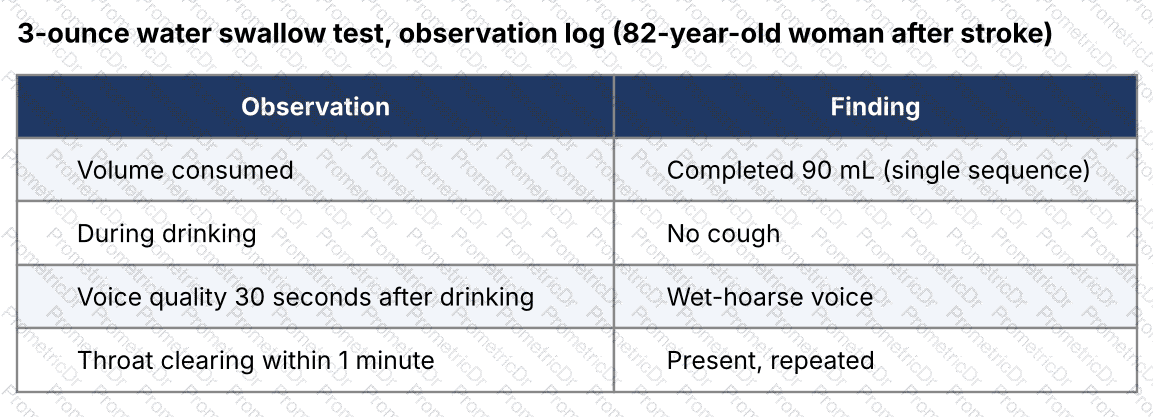
What is the MOST appropriate interpretation of this test and next step?
Question # 19

Exhibit: 3-ounce water swallow test, observation log (82-year-old woman after stroke)

Options:
A.

  Pass; resume thin liquids

B.

  Pass because there was no cough

C.

  Inconclusive; repeat immediately 3 times

D.

  Fail; wet-hoarse voice and throat clearing within one minute suggest possible aspiration, so keep NPO or modify oral intake and complete a comprehensive swallow evaluation with instrumental assessment as indicated

Question # 20

Which feeding approach is MOST appropriate for an infant with an unrepaired cleft palate?

Options:
A.

  Standard bottle with narrow nipple

B.

  Specialized bottles (e.g., squeezable or one-way valve bottles) and nipples that reduce the effort needed, upright or semi-upright positioning, and monitoring of growth

C.

  Breast only, with no support

D.

  Spoon-feeding from birth

Viewing page 2 out of 3 page
Industry research shows that students who utilize DHA Speech Therapy practice tests are significantly more likely to pass exam.
Go to DHA Speech Therapy Exam Main Page

DHA Speech Therapy Overview

Vendor: DHA Prometric
Name: Dubai Prometric Speech Therapist Exam
